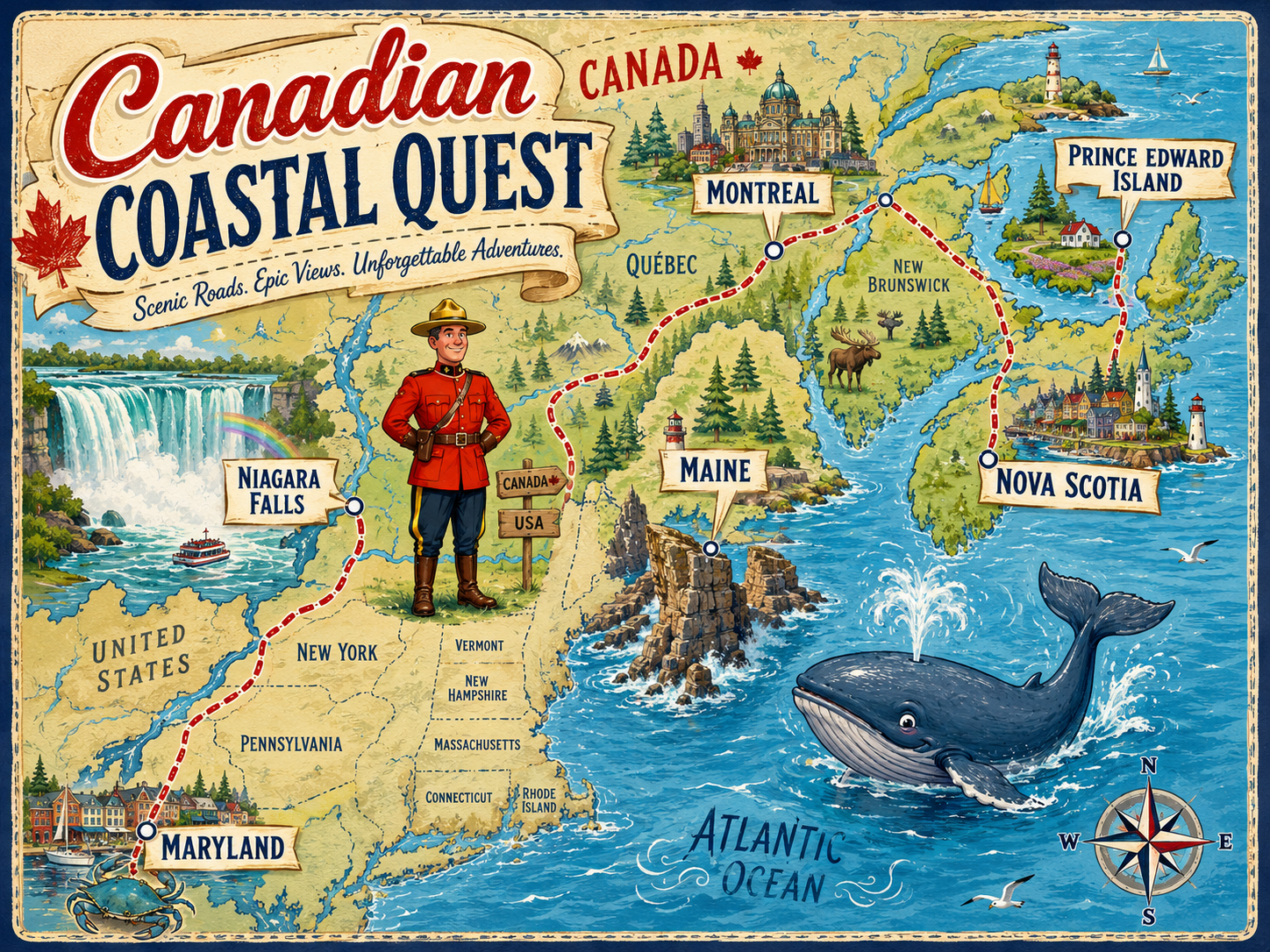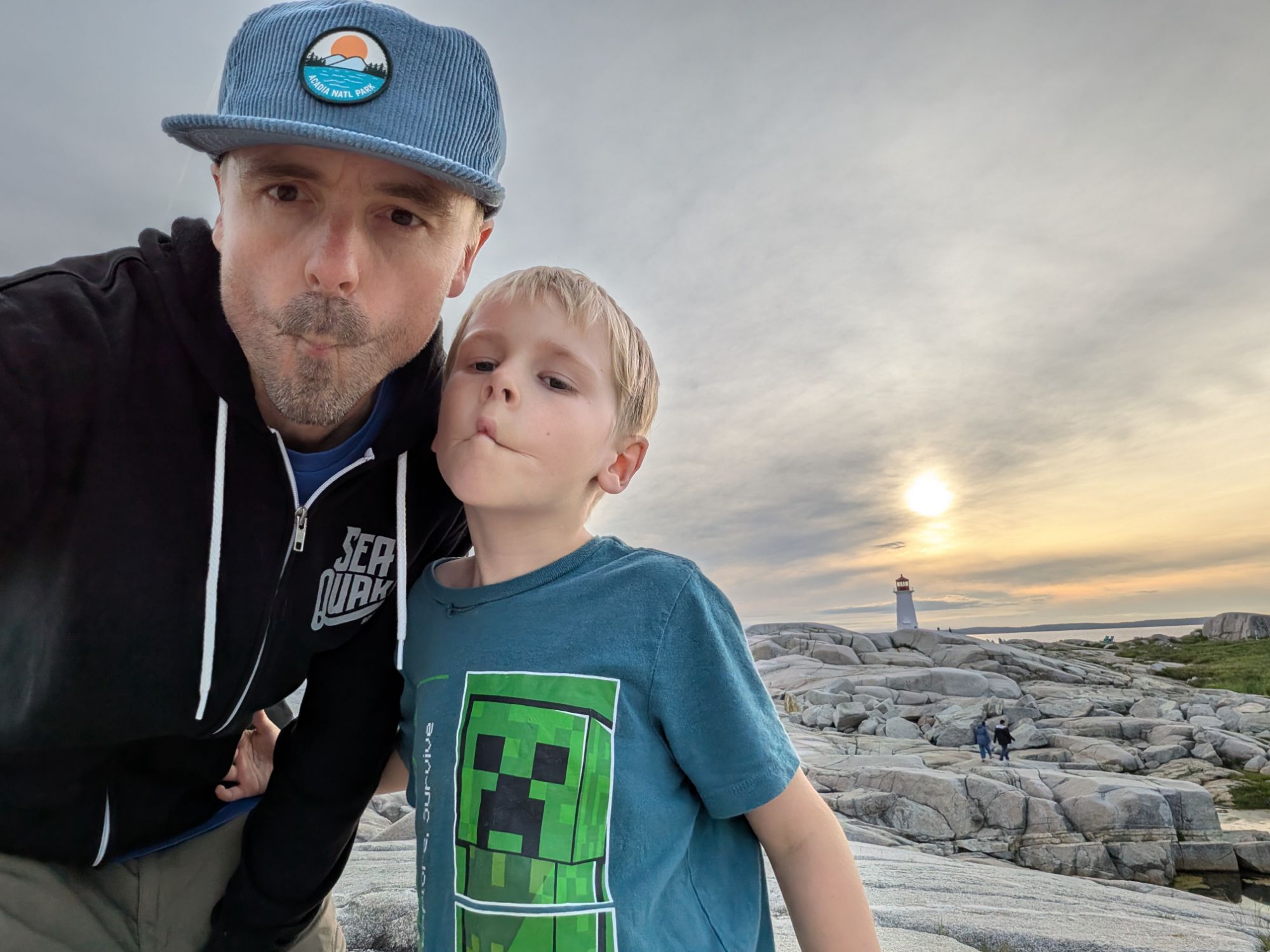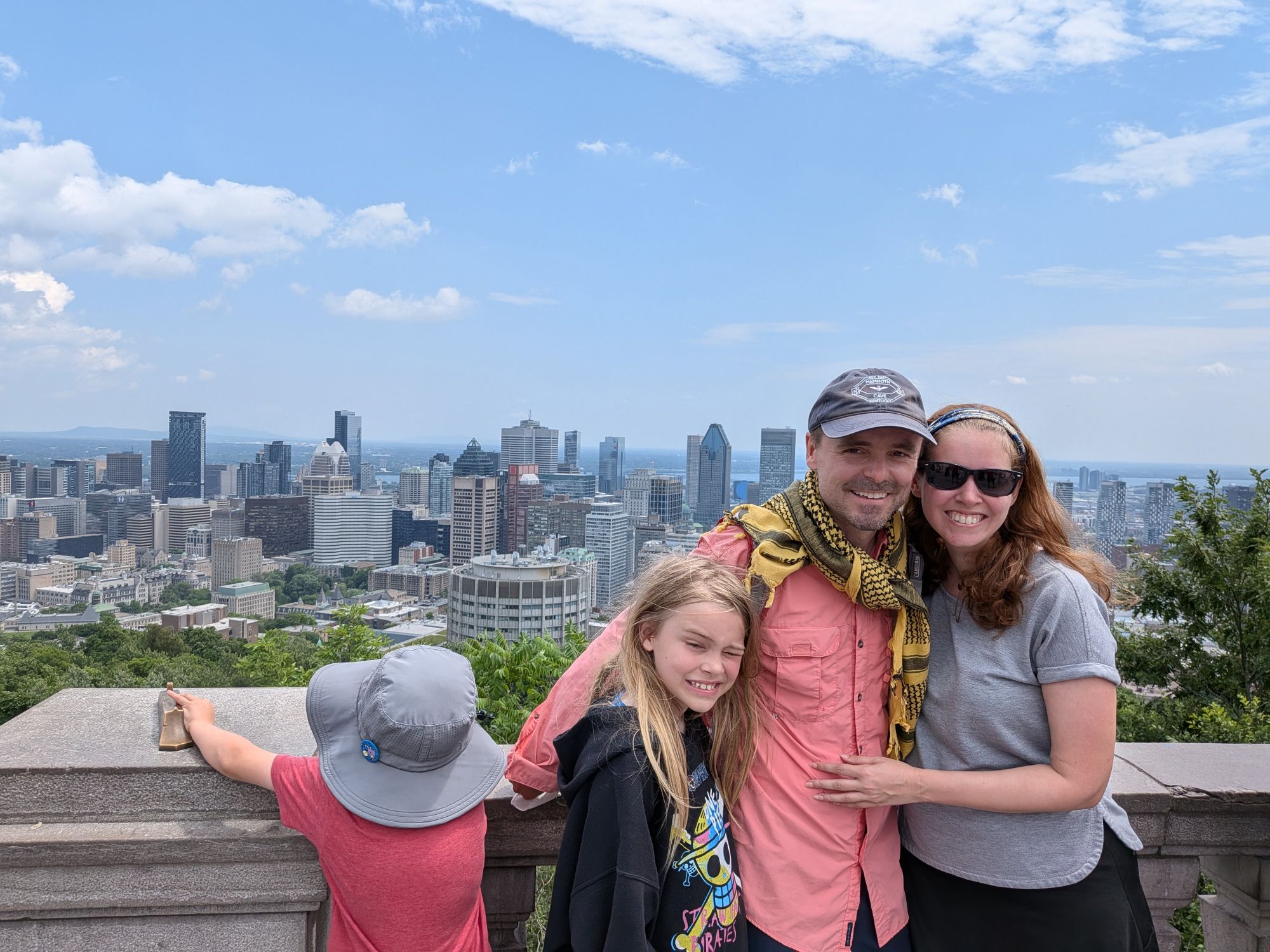
First post of our Great North family road trip: cousins, dogs, kitties, American Revolution history, Philly cheesesteaks, one very naughty candy bag, and the first sweep of New England coast.
Every big road trip has a moment when it stops being a plan and starts being real. For our Canadian Coastal Quest, that moment came somewhere between pulling into camp after dark, borrowing a bike for a solo dad ride, watching the boys soak in American history, and trying to explain to Stella why eating an entire bag of camper candy was a very bad life choice.
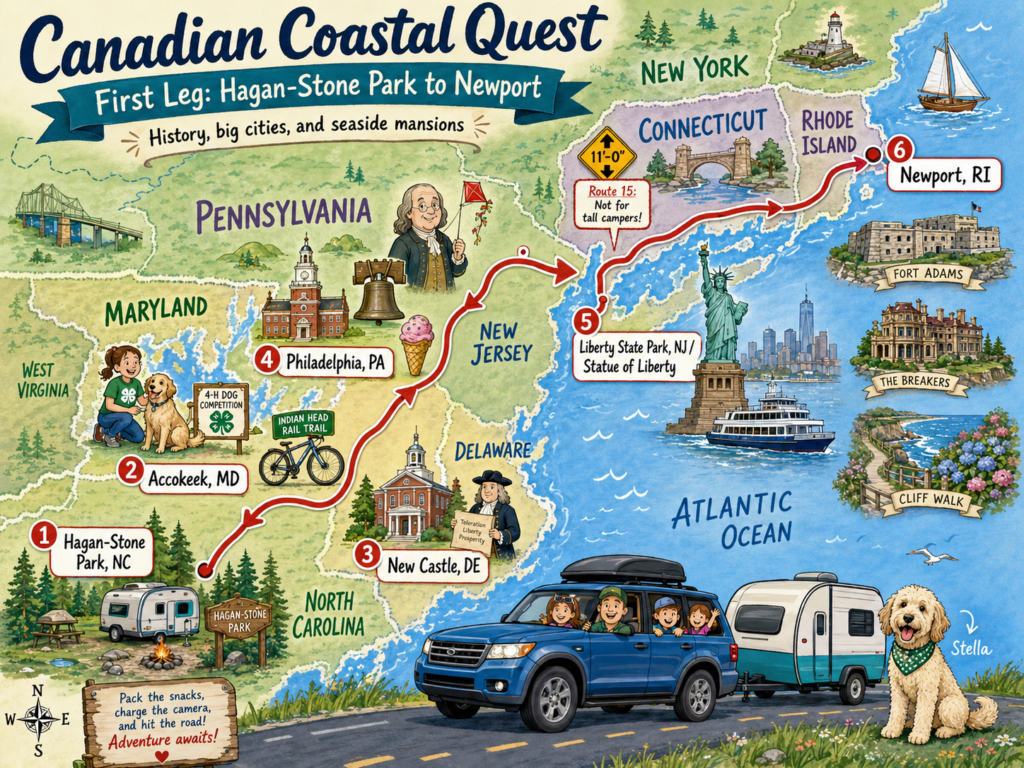
This first leg took us from the Southeast up through Maryland, Delaware, Philadelphia, New Jersey, New York Harbor, Connecticut, and finally to Newport RV Park in Rhode Island. The theme, without planning it too perfectly, became the making of America: colonies, constitutions, revolution, liberty, and then a hard turn into Gilded Age mansions where America’s early industrial fortunes were spent on summer “cottages” larger than most public buildings.
Not a bad way to start a road trip.
Hagan-Stone Park: The $25 Overnight Winner
Our first stop was Hagan-Stone Park in Guilford County, North Carolina, which immediately earned a place in the road trip hall of fame for one simple reason: $25 per night.
We arrived just after dark, did the classic “everyone grab something and pretend we know exactly where it goes” camper setup, and then turned around the next morning by 7:30 a.m. It was not a long stay, but it was quiet, affordable, easy, and exactly what we needed for a first-night stopover.
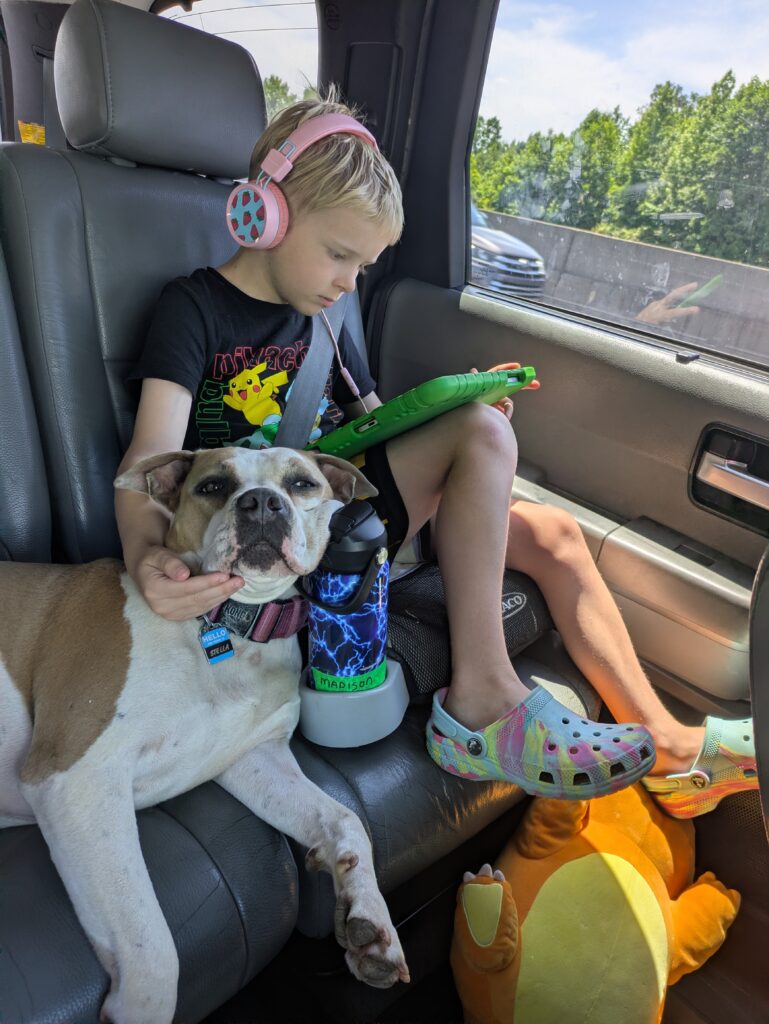
Accokeek, Maryland: Cousins, Dogs, Bikes, and Kitties
From North Carolina, we made our way to Lacy’s house in Accokeek, Maryland, which is always one of those stops that feels less like logistics and more like the trip really beginning. Cousins were reunited, the adults got to catch up, and the kids got their first big dose of summer adventure.
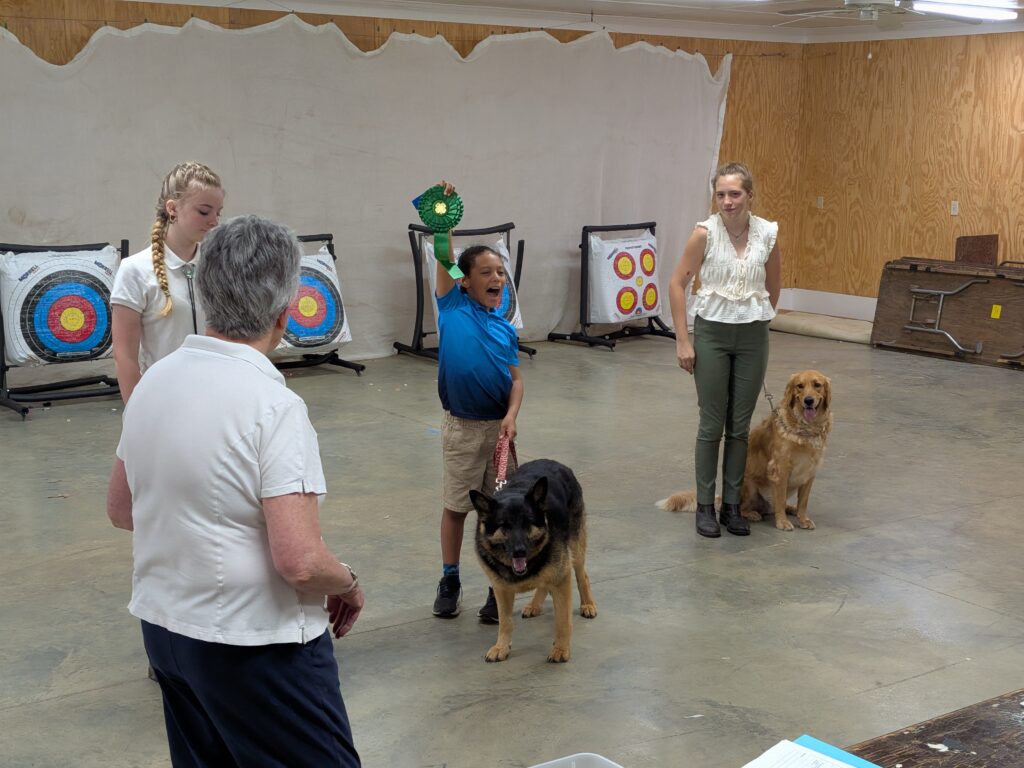
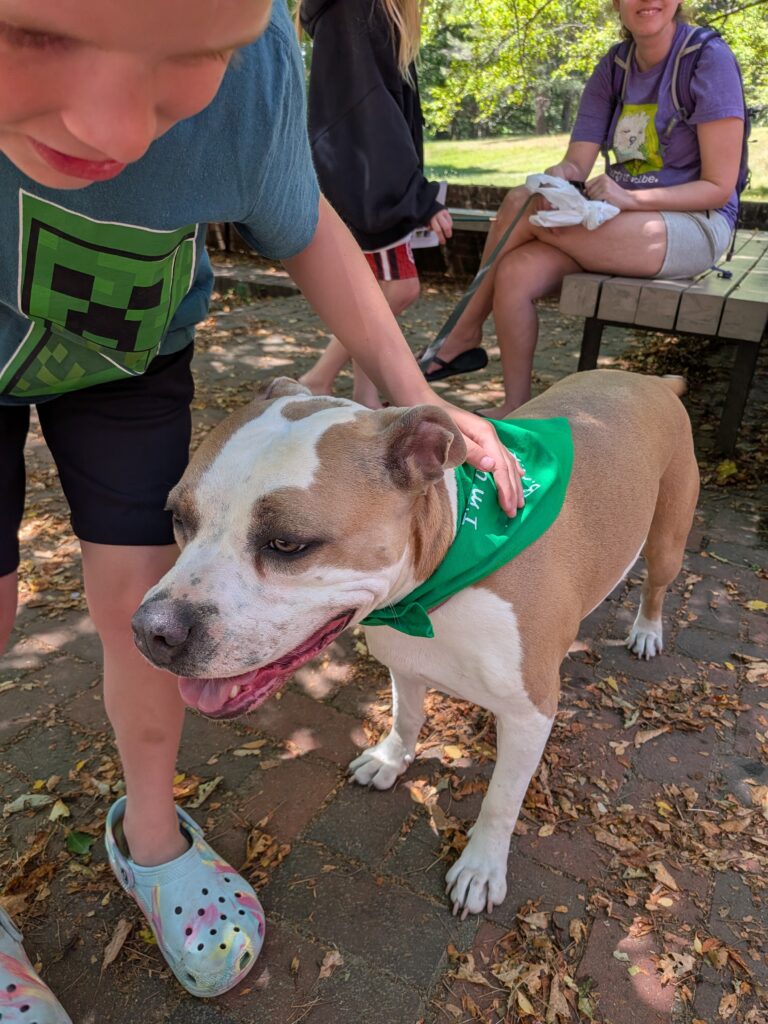
The main event was the 4-H regional qualifier for beginning and novice dog competition. The competition included three events: showmanship, obedience, and rally. Lucas and his trusty companion Lava stole the obedience show with a near-perfect execution of the figure eight. It was one of those proud cousin moments where everyone is watching, the dog is locked in, and the kid looks like he has been training dogs professionally since kindergarten.
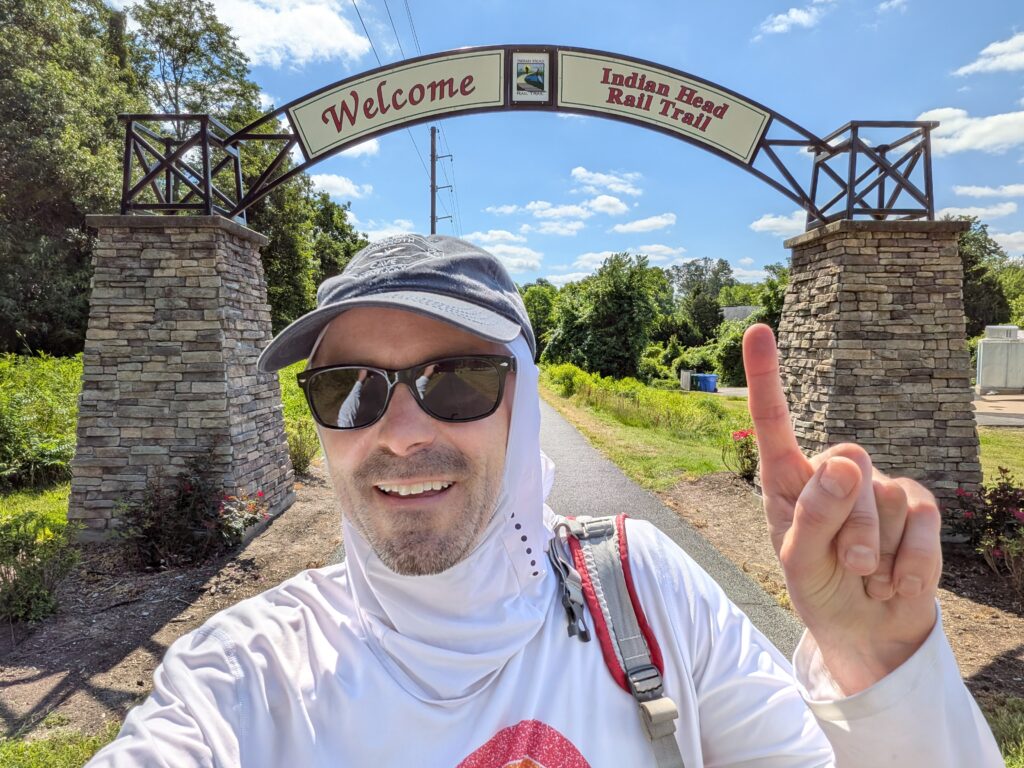
While the kids had cousin time, Dad borrowed a bike and took a rare “me day” ride on the Indian Head Rail Trail. The trail runs about 13 miles from White Plains in Charles County toward the Navy base in Indian Head, making it a 26-mile out-and-back ride. It is flat, straight, peaceful, and just repetitive enough to become meditative. After a few days of packing, driving, camper prep, and family logistics, 26 quiet miles on a bike felt like hitting the reset button.
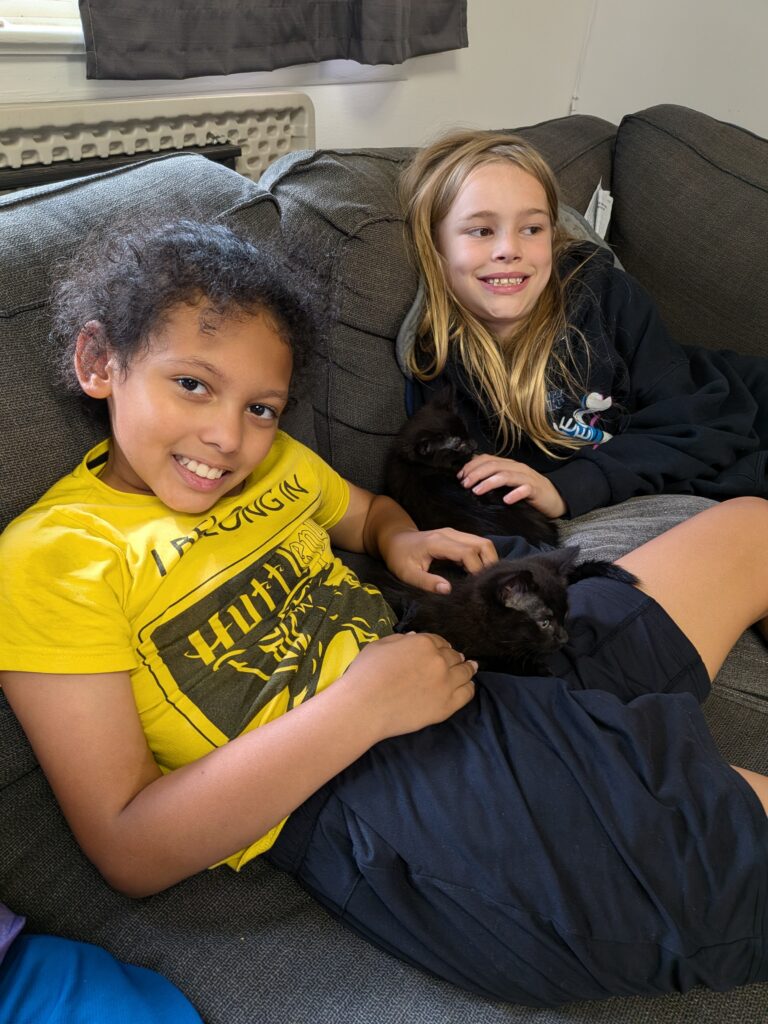
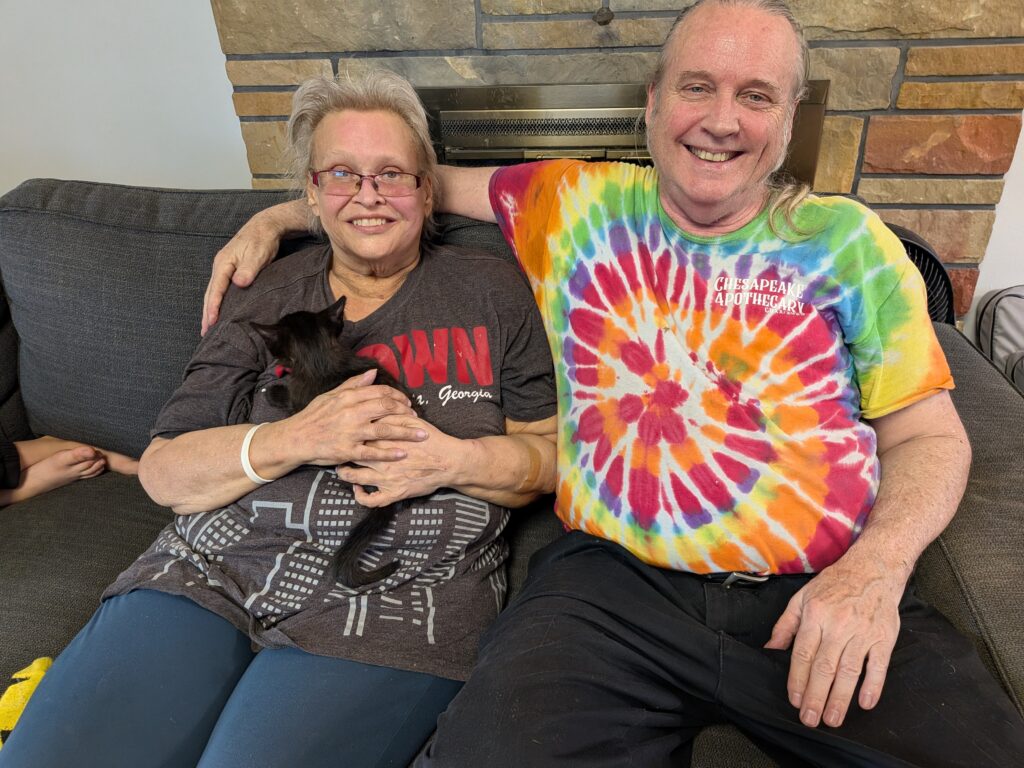
The boys also got to meet Gran and Granny’s newest litter of kittens, which naturally became a full kitty-petting session. If you ever need to slow down six energetic boys, apparently the answer is tiny kittens.
New Castle, Delaware: A First State History Stop
From Accokeek, we pointed the Sequoia and camper north toward the Philadelphia South / Clarksboro KOA, with one important history stop on the way: First State National Historical Park in New Castle, Delaware.
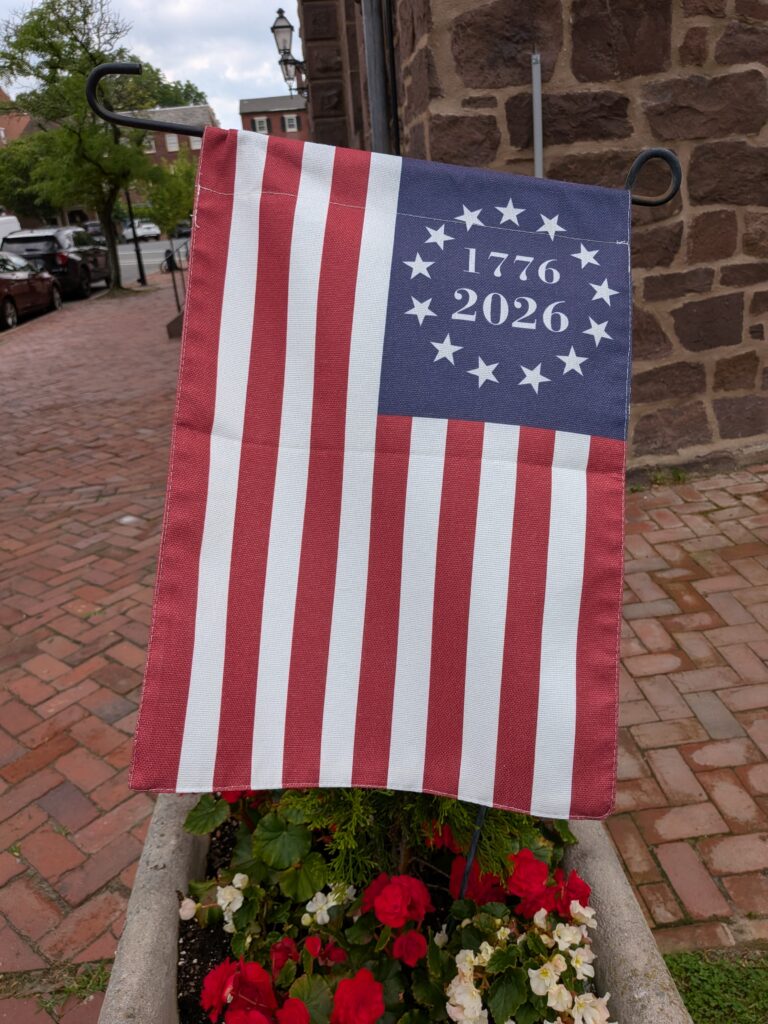
New Castle is one of those towns that feels like it should come with a tri-corner hat and a horse tied up outside the courthouse. We walked the grounds, explored the historic courthouse area, and soaked in the early American history. The New Castle Court House was built in 1732 and later became the place where Delaware declared independence from both Pennsylvania and Great Britain in 1776.
That is a pretty strong road trip stop.
Delaware’s identity as the “First State” comes from being the first to ratify the U.S. Constitution in 1787. For a small colony, equal footing with the larger states was a very big deal. The idea that each state would have a meaningful voice helped make the new system work, and standing there in New Castle made that piece of the founding story feel a little more real.
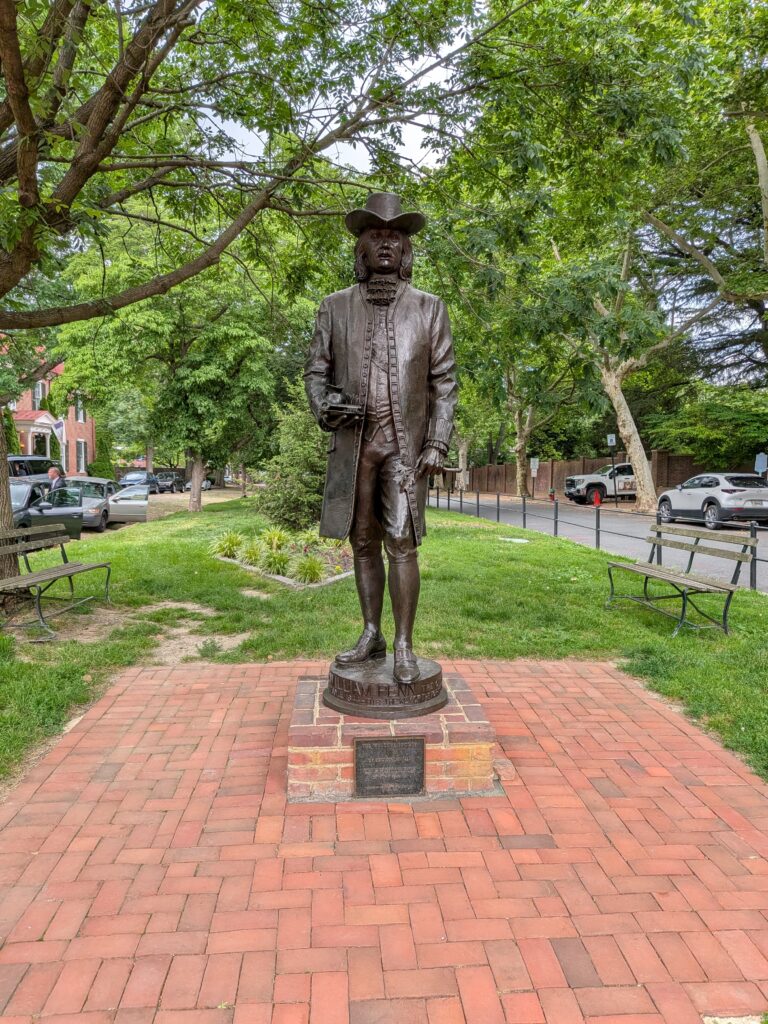
We also bumped into a statue of William Penn, who founded Pennsylvania and played a major role in shaping the region. It was a fitting transition from Delaware into Philadelphia, where Penn’s legacy and America’s founding story would keep following us around every corner.
Philadelphia: Independence, Coins, Ice Cream, and Cheesesteaks
Philadelphia was hot. Not just “summer in the city” hot. More like “95 degrees and everyone deserves ice cream before anyone asks another historical question” hot.
But Philadelphia is also one of the best family history stops in America. It is compact, walkable, full of major sites, and packed with the kind of stories kids can actually follow: kings, taxes, rebellion, bells, coins, printing presses, and a bunch of people arguing in rooms until they accidentally built a country.
Starting at the U.S. Mint
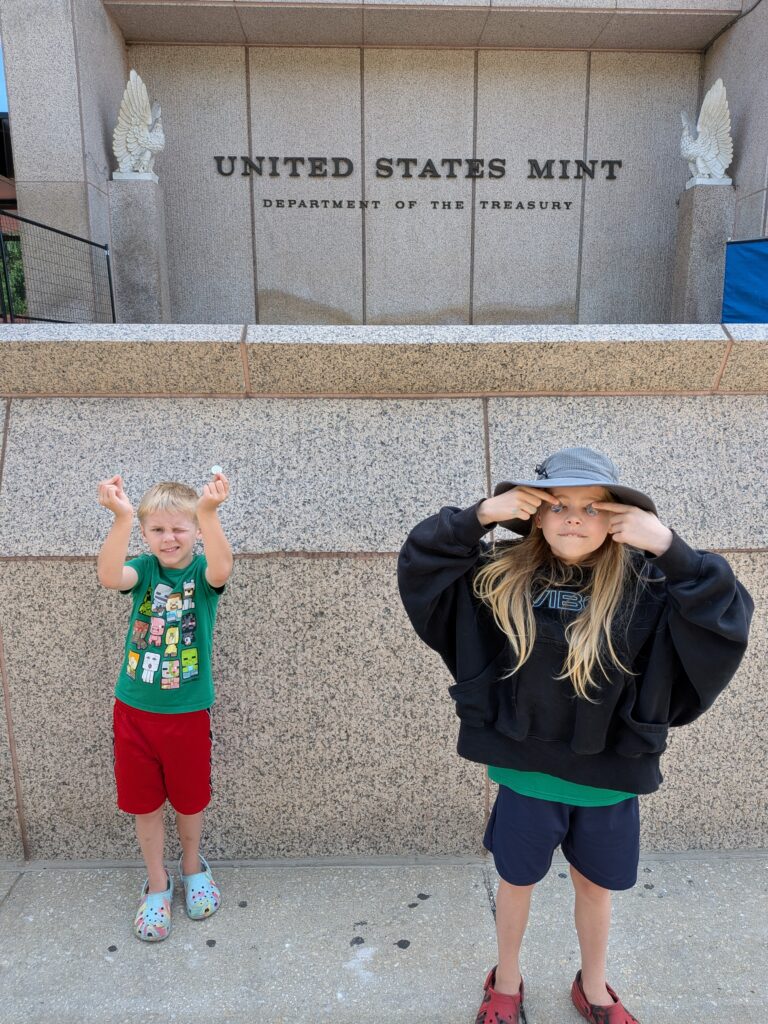
We started at the United States Mint in Philadelphia, where visitors can watch coin production from above the factory floor. The boys got to see coins being made, picked up some new quarters, and even designed their own quarters. For kids, this was a perfect first stop: loud machines, shiny coins, and just enough history to keep the adults happy.
Independence Hall and the Big Ideas
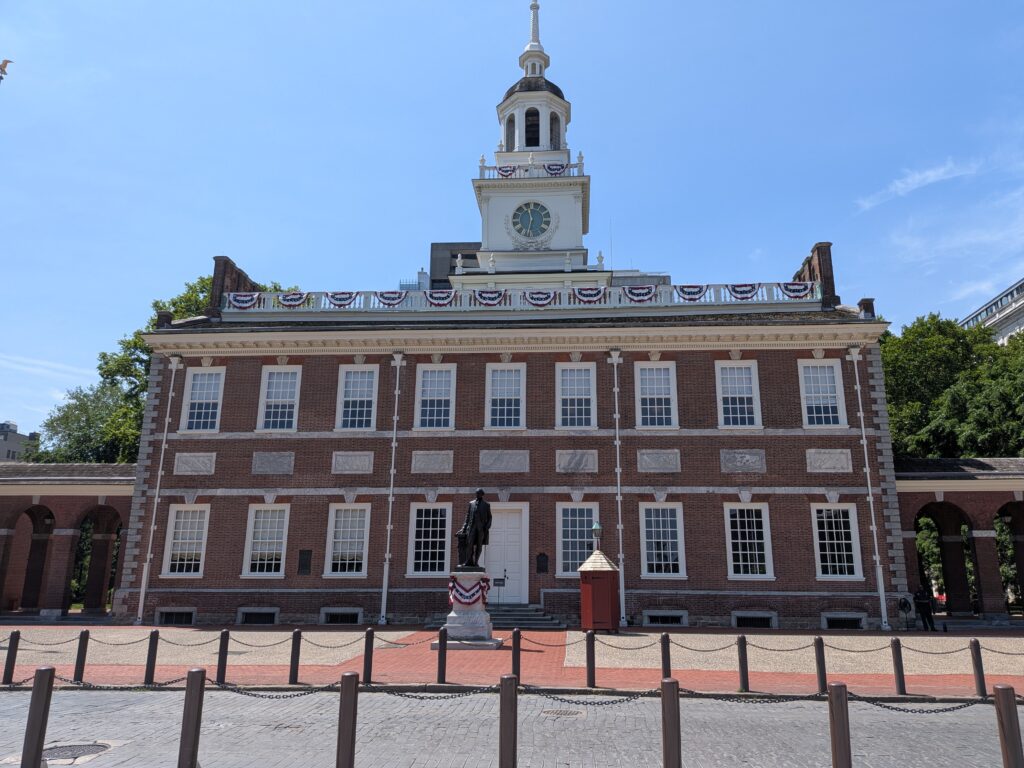
From there, we moved into the heart of Independence National Historical Park. Independence Hall is one of those places where the name undersells the story. The building we now call Independence Hall became famous because the Declaration of Independence and the U.S. Constitution were both debated and signed there.
The guide helped connect the dots for the kids. In the early 1700s, Pennsylvania was still tied to William Penn’s family and proprietary rule. Colonists wanted more say in their own government. By 1775, after fighting broke out between colonial militias and the king’s army, the Continental Congress gathered in Philadelphia. Thomas Jefferson drafted the Declaration of Independence, with help and edits from others including Benjamin Franklin and John Adams, and on July 4, 1776, the colonies formally declared independence.
Then came the hard part: actually winning the Revolutionary War.
The British invaded New York. Washington retreated. The war dragged on. Eventually, the decisive victory at Yorktown helped secure American independence. But even after the war, the new states still had to figure out how to govern themselves without falling apart over power, money, representation, and regional interests.
That led to the Constitution, the three-branch system of government, and later the Bill of Rights. The line that stuck with us was Benjamin Franklin’s famous warning when asked what kind of government the founders had created: “A republic, if you can keep it.”
That one hits a little differently when you are standing in the place where the arguments happened.
Ben Franklin, Free Quakers, and a Printed Declaration
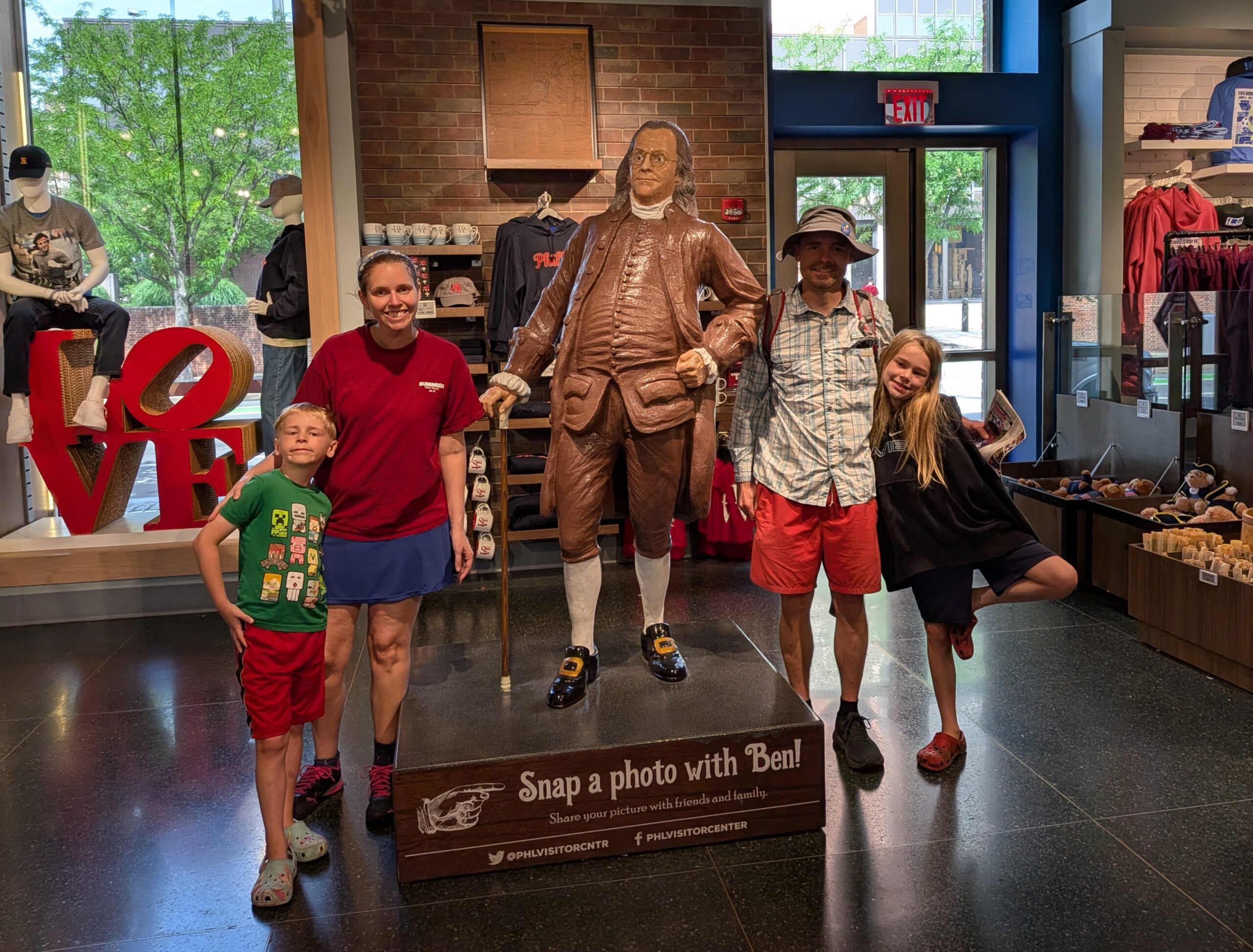
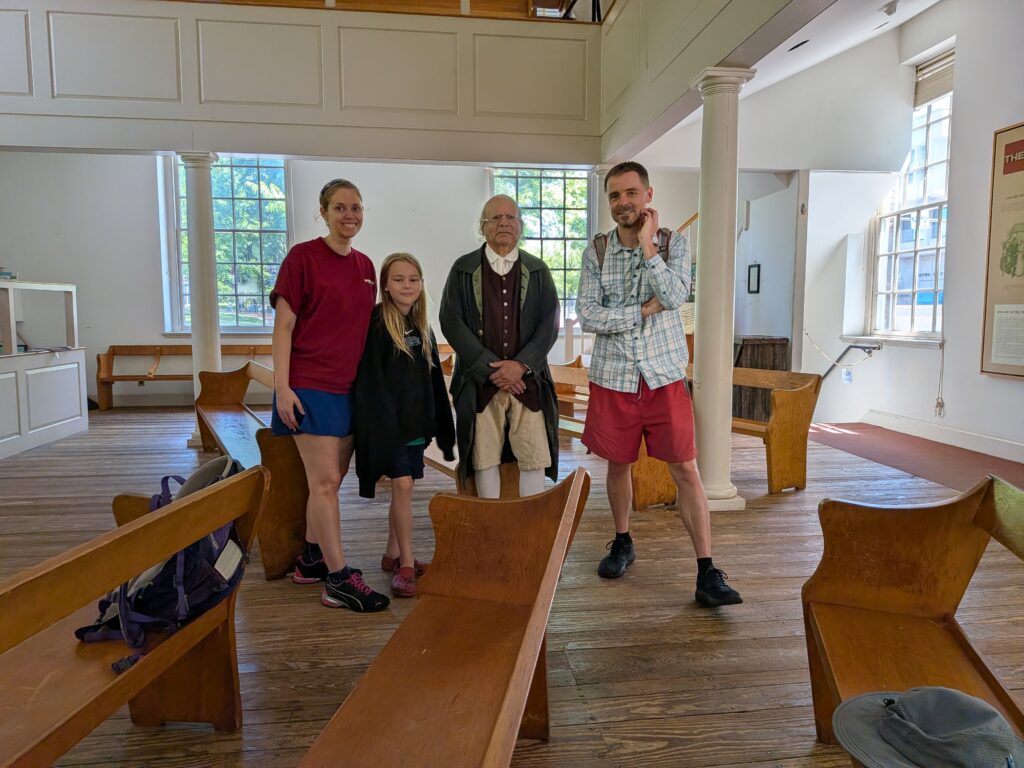
Philadelphia is also a great place to let the kids bump into history instead of just hearing about it. At the Free Quaker Meeting House, we ran into Benjamin Franklin, or at least a very convincing version of him, which is exactly the kind of thing that makes a city history day memorable.
Then we headed to Franklin Court, where we visited the area connected to Ben Franklin’s printing press and post office. We picked up an authentically printed Declaration of Independence, which felt like the perfect souvenir from a day built around founding documents.
Liberty Bell and the Symbol That Outlived the Sound
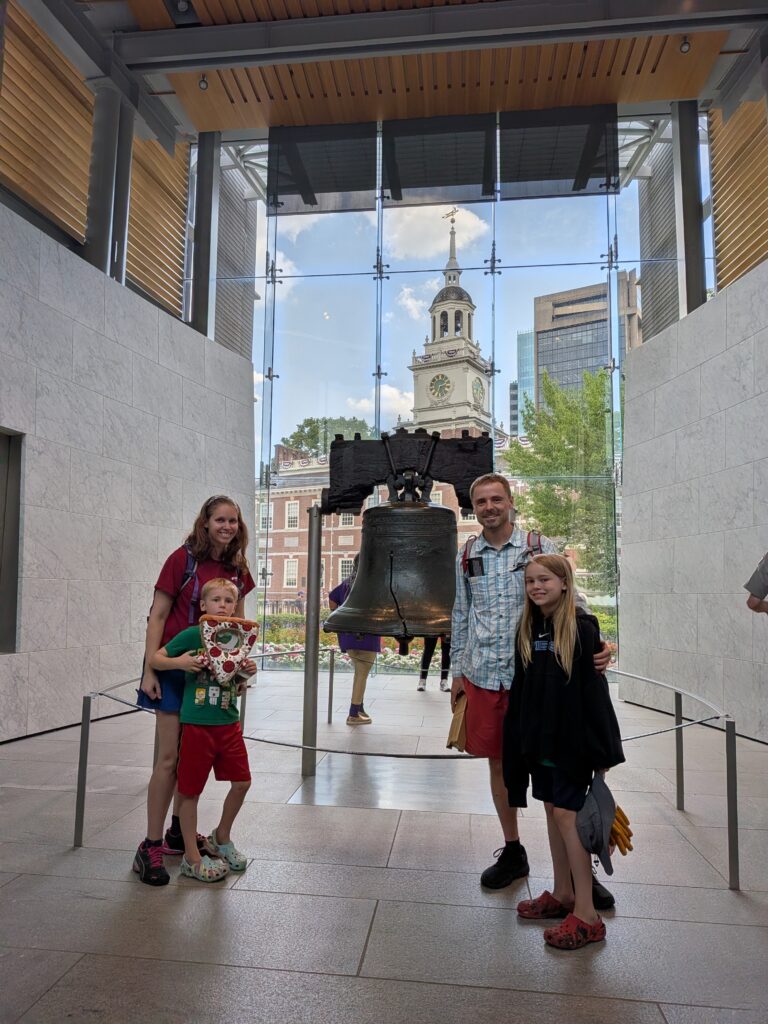
Next up was the Liberty Bell. The Liberty Bell is one of those symbols everyone recognizes, but the story is more interesting than just “old bell with a crack.” The National Park Service explains that the wide crack we see today is actually part of a past repair attempt. A later fissure ran through the word “Liberty” and silenced the bell for good.
And yet, somehow, becoming unusable made it more powerful. The bell became a lasting symbol of freedom, abolition, civil rights, and the long, unfinished American argument over what liberty really means.
Ice Cream, Cheesesteaks, and Friends
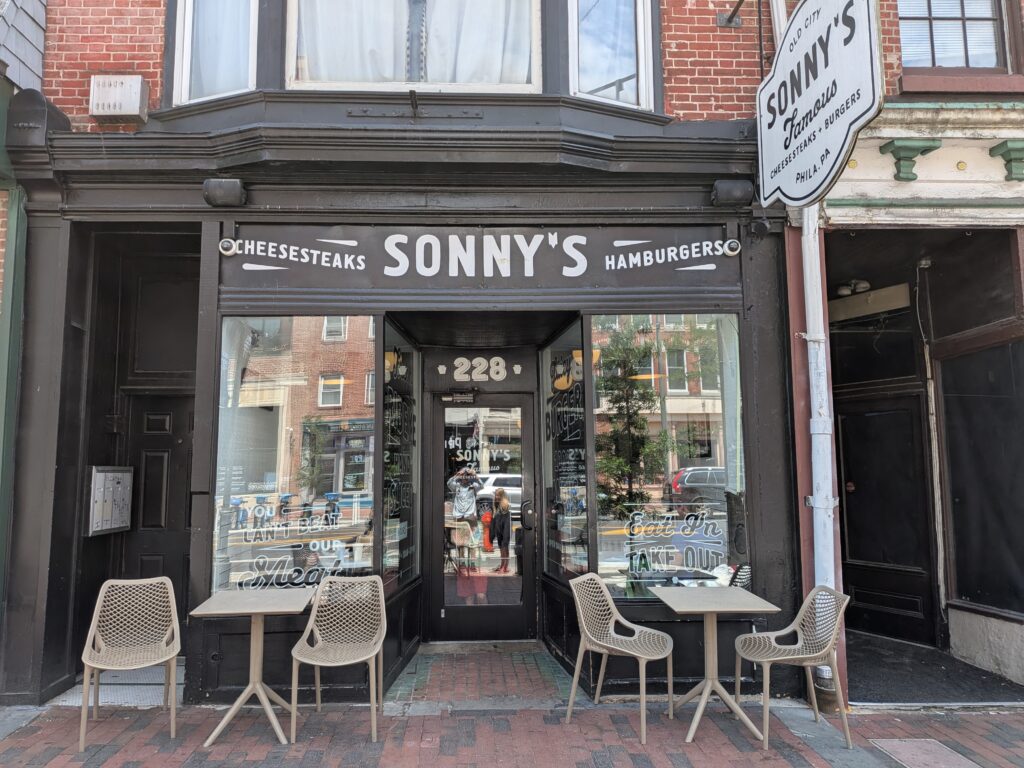
By this point, everyone had earned a break. We stopped at The Franklin Fountain for ice cream, which was not optional in the 95-degree heat. The boys crushed some well-earned scoops, and then we headed over to Sonny’s Famous Steaks for authentic Philly cheesesteaks.
History is important. So is melted cheese.
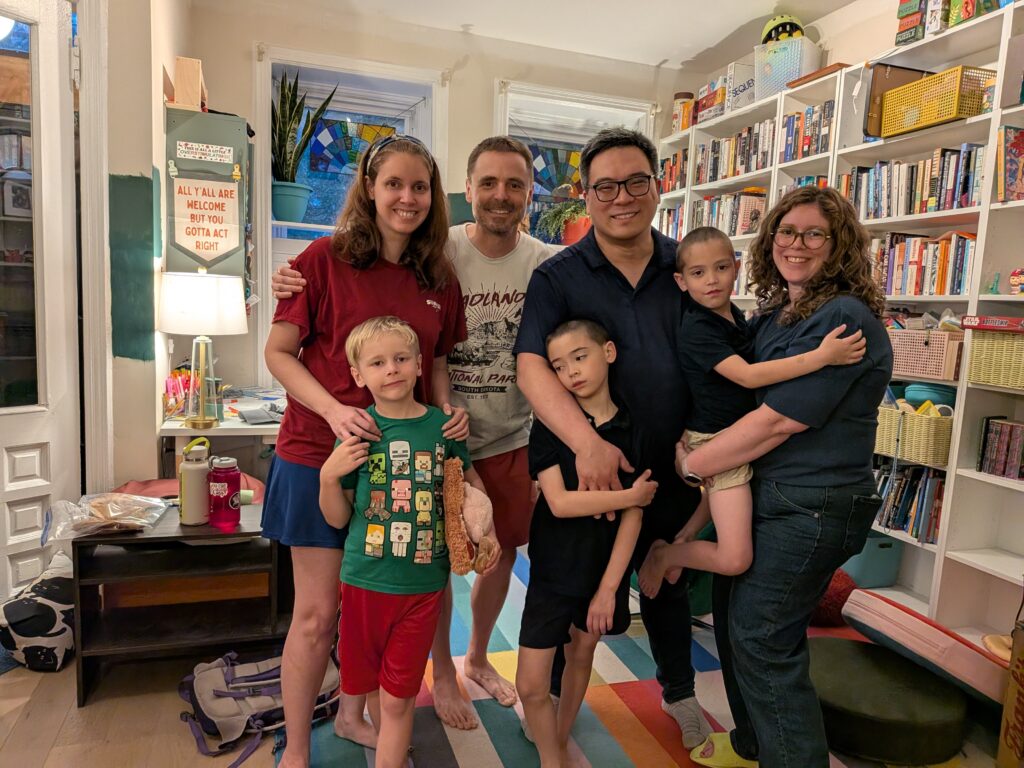
That evening, we had dinner with Cassy’s former colleague Henry, his wife Sharon, their two boys, and their three cats. It was a great way to end a big city day: friends, food, kids, cats, and the comfort of sitting down somewhere that was not a camper seat.
Stella’s Candy Escapade
Back at the camper, the mood shifted when we noticed a bunch of candy was missing. After a quick investigation, we realized Stella had gotten into Cassy’s candy bag.
This is where every dog owner knows the feeling: concern, guilt, frantic Googling, and staring at the dog like she might provide a written inventory of what she ate.
Stella looked very plump and very suspicious. Later that evening, she threw up all over the camper. We felt terrible for her, and she looked absolutely miserable. Thankfully, she made it through the candy crime spree, but it was a strong reminder that camper snacks and dogs need to be separated like church and state.
From Philadelphia to Liberty State Park and the Statue of Liberty
The next morning, we packed up and drove from Philadelphia toward Rhode Island, with a major stop at Liberty State Park in New Jersey.
Caption: Philadelphia to Newport with a big New York Harbor stop at Liberty State Park.
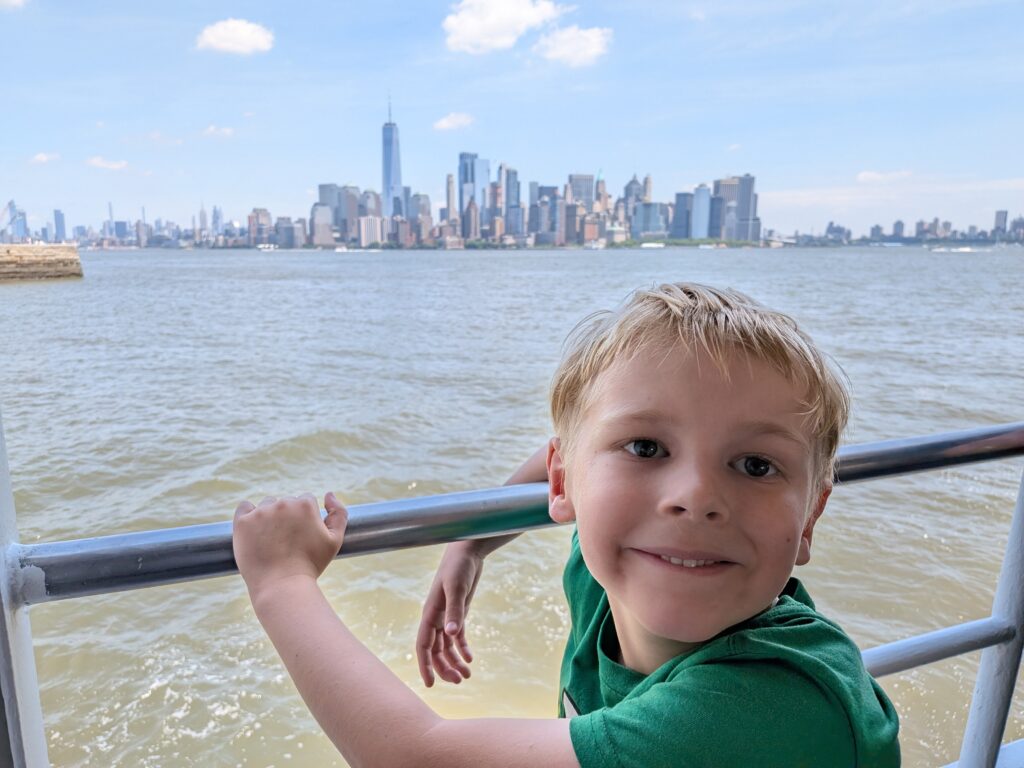
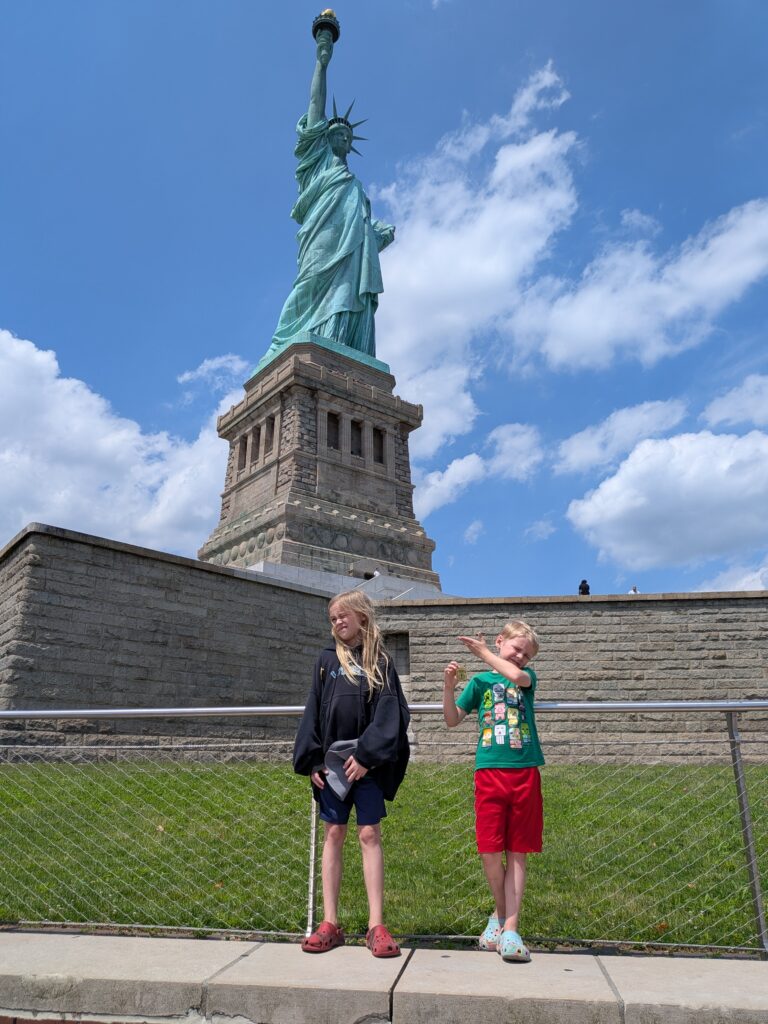
Liberty State Park is a great way to visit the Statue of Liberty without driving directly into Manhattan. Cassy stayed back with Stella while Dad and the boys took the ferry over to Liberty Island.
The Statue of Liberty was a gift from the people of France, commemorating the alliance between France and the United States during the American Revolution. It was dedicated in 1886 and stands 305 feet, 1 inch from the ground to the tip of the torch. At the time, it was one of the most impressive monuments in the world, and it still feels enormous when you are standing at the base looking up.
For the boys, this was one of those classic road trip moments: ferry ride, skyline views, giant statue, and a history lesson that did not require sitting still in a classroom.
The Drive to Rhode Island: A Camper Warning About Connecticut Route 15
After the Statue of Liberty, we got back on the road for Rhode Island. The route took us through New Jersey, New York, Connecticut, and Massachusetts before finally reaching Newport.
And then came the camper lesson of the day.
Google Maps tried to send us onto Connecticut Route 15. A word of wisdom for anyone traveling this way with a camper: Route 15 is not for vehicles over 8 feet high. That is a problem when you are towing a travel trailer that is definitely taller than 8 feet.
We had to take a very circuitous route through Connecticut neighborhoods to get back onto roads that worked for our setup. It was stressful, slow, and a good reminder that normal navigation apps are not always RV-friendly. If you are towing a camper through the Northeast, double-check your route for low clearances and parkway restrictions before you get boxed into a bad situation.
Newport, Rhode Island: Forts, Sailboats, Mansions, and Cliff Walks
We finally arrived at Newport RV Park in Rhode Island, which became our base for exploring one of the prettiest coastal towns in New England.
Newport is ridiculously charming. It has harbor views, sailboats, historic streets, old-money mansions, salty air, and the kind of downtown that makes you want to park the car and wander with no particular plan.
Fort Adams and the Bay Walk
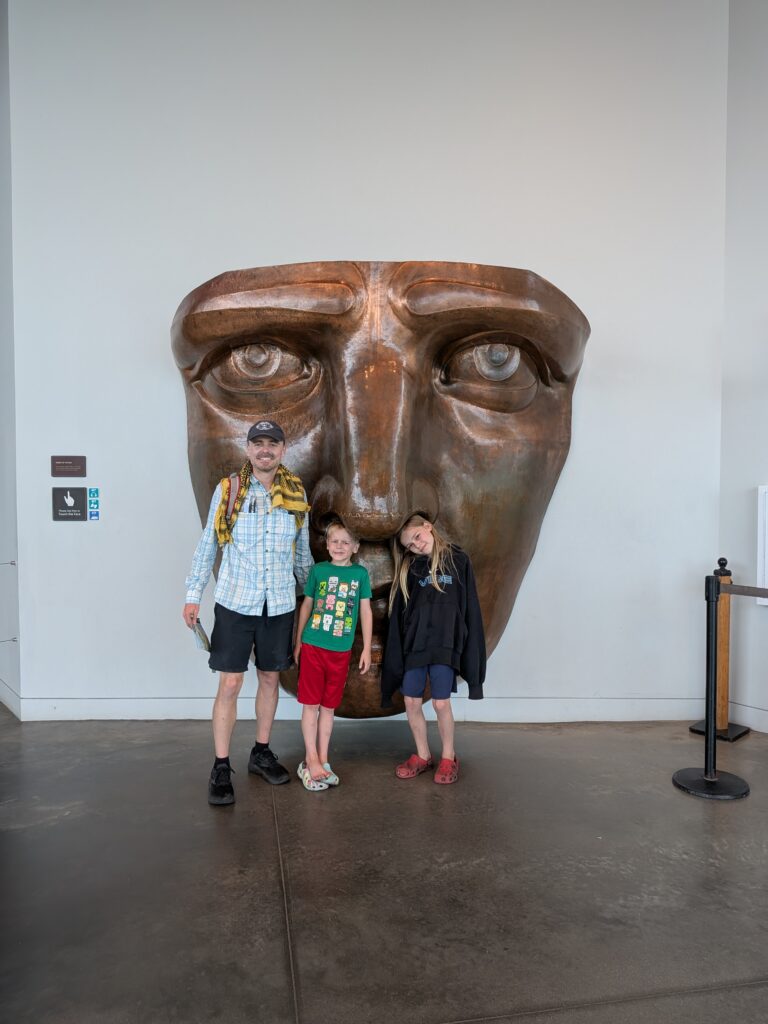
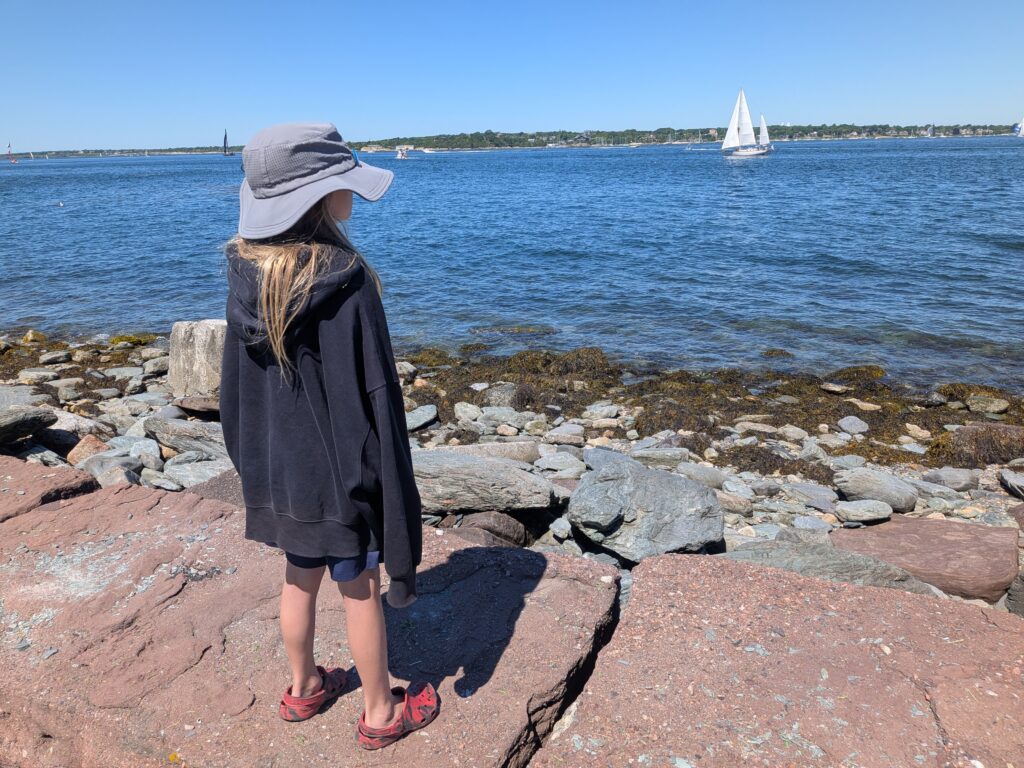
In the morning, we went to Fort Adams State Park and walked along the bay to watch sailboats move in and out of the harbor. Fort Adams is not an active fort today, and it never saw battle, but it remains one of Newport’s signature historic places.
These days, Fort Adams is also known for hosting major summer events, including the Newport Folk Festival and Newport Jazz Festival. The setting is hard to beat: old stone fort, green lawn, blue water, sailboats, and music history layered right on top of military history.
Mansions From Another Time
Newport also gave us a totally different American history theme: the Gilded Age.
After spending days talking about independence, representation, liberty, and revolution, we suddenly found ourselves driving past massive summer homes built by the wealthy families of the late 19th century. These were the mansions of America’s industrial elite, sometimes called robber barons, and Newport became one of their favorite places to show off wealth on a truly unbelievable scale.
The Preservation Society of Newport County now cares for many of these historic properties, including famous homes like The Breakers. They were called “summer cottages,” which is funny only because some of them are larger than entire hotels.
Standing in Newport, it is easy to see two versions of American history sitting next to each other: the revolutionary idea that power should not belong only to kings, and the Gilded Age reality that money could still build palaces by the sea.
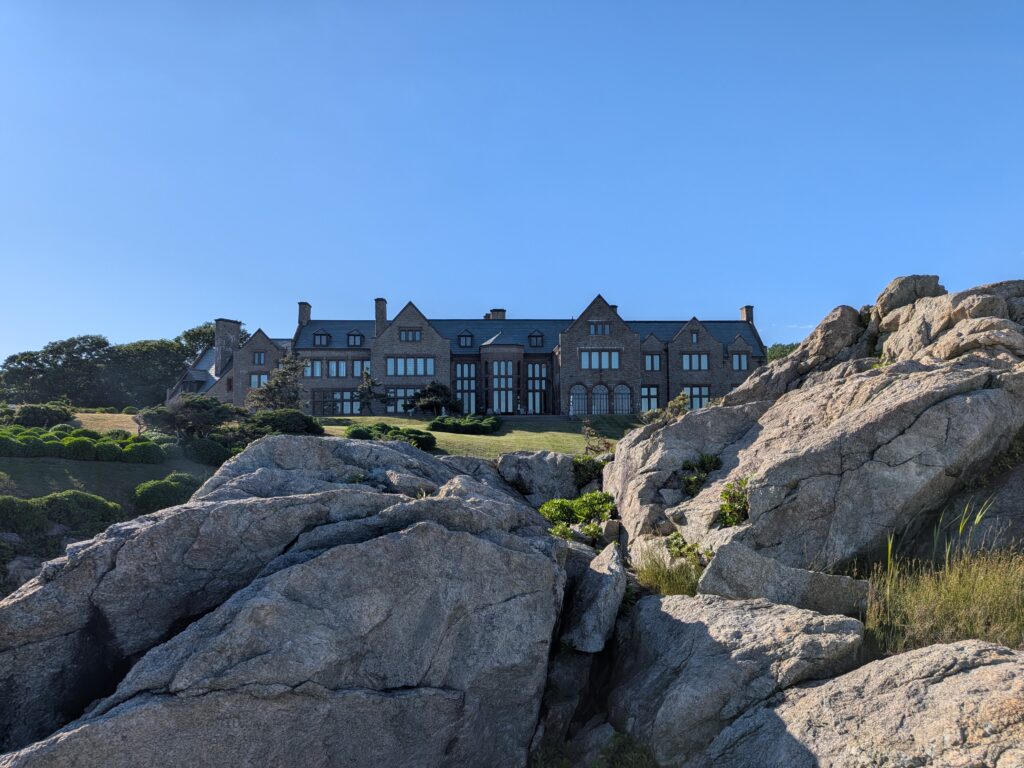
Caption: Newport’s Gilded Age mansions turned the coastline into a showcase of American wealth.
The Cliff Walk
Near the mansions is Newport’s famous Cliff Walk, a scenic coastal path that runs along the edge of the Atlantic with ocean views on one side and Gilded Age mansions on the other.
Dad took a solo outing to run among roses, daisies, sea breeze, and rocky edges. Parts of the walk are smooth and easy, while other parts invite a little rock scrambling, which of course presented it’s challenges. It was the perfect evening setting: flowers in bloom, waves below, mansions above, and dad getting out his energy.

Stella’s Big Birthday Party
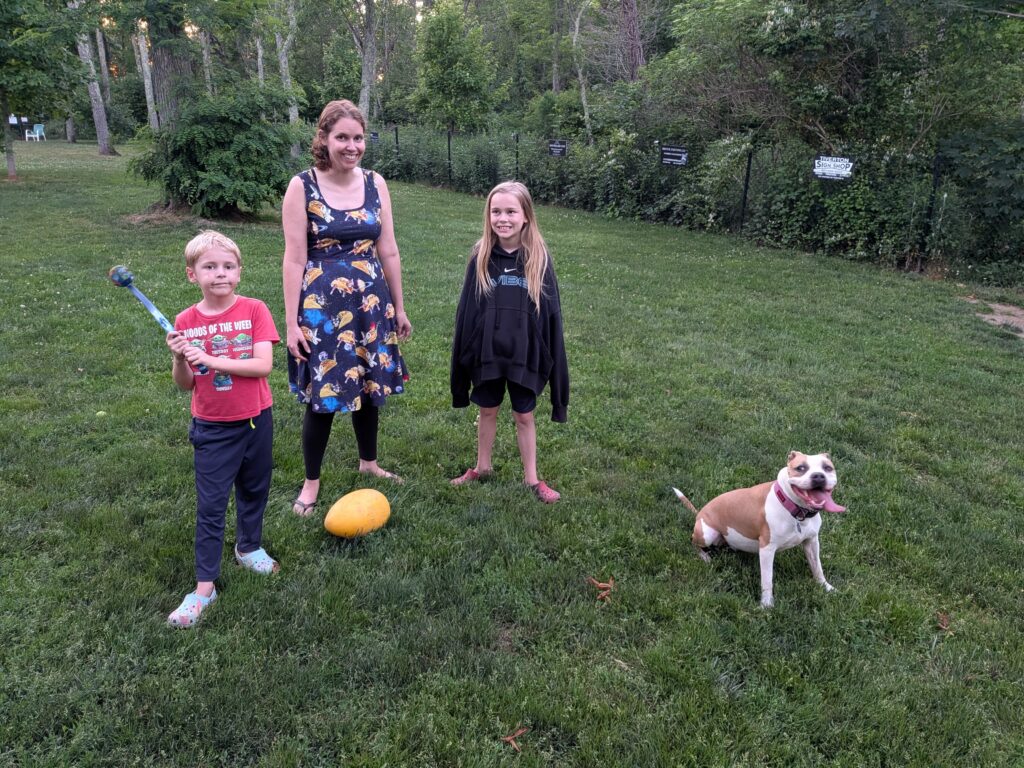
On July 14, 2026 we celebrated two birthdays: Stella’s and Pop’s. Stella got a “huckit” ball throwing toy from Madison and we took her to the dog park to work out her pent up riding in the car energy.
Public Service Announcement: The Ticks Are Not Playing Around
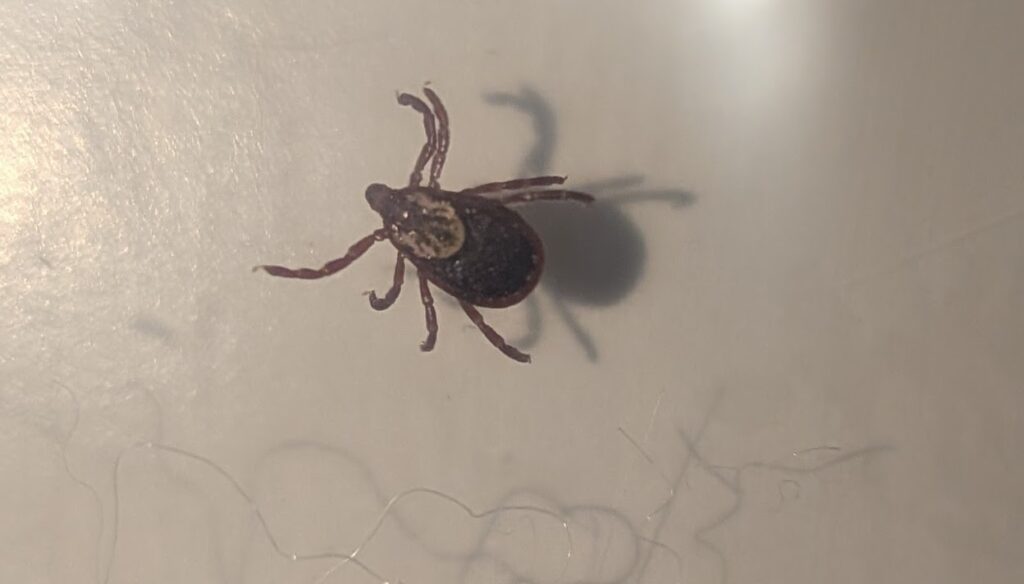
One practical note from this stretch of the trip: ticks are highly active in the Northeast right now.
We were warned ahead of time, so we have been doing regular daily tick checks. Stella is currently the unfortunate winner with seven ticks total: three at Lacy’s and another four in Newport. Ticks can carry diseases, including Lyme disease, so daily checks are important for kids, adults, dogs, clothes, and gear. This is a contest no one wants to win.
Our road trip rule now: if you walked through grass, woods, flowers, trails, or anything remotely tick-friendly, you get checked.
Minute Man and Maine
From Newport, we continued north toward York, Maine, with one more major American Revolution stop on the way: Minute Man National Historical Park outside Boston.
Minute Man preserves the landscape where the opening battle of the American Revolution unfolded on April 19, 1775. This is where the “shot heard round the world” helped ignite the fight for independence.
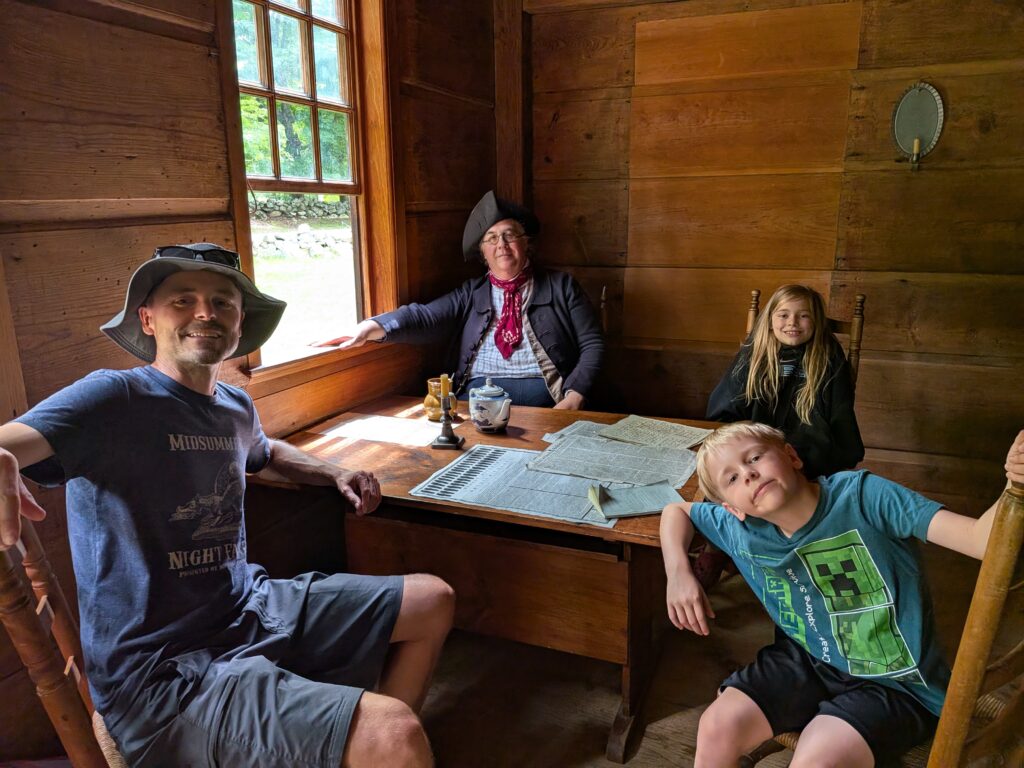
It felt like the perfect bridge between this first leg and the next chapter of the trip. We had started with colonial government in Delaware, walked through independence in Philadelphia, stood beneath liberty in New York Harbor, explored Gilded Age Newport, and were now heading toward the battlefields where the Revolution truly began.
Not bad for the first stretch of a family road trip.
Next stop: Maine, rocky coastlines, more cousins, and the official beginning of our push toward Atlantic Canada.
Discover more from Dad Can Travel
Subscribe to get the latest posts sent to your email.